
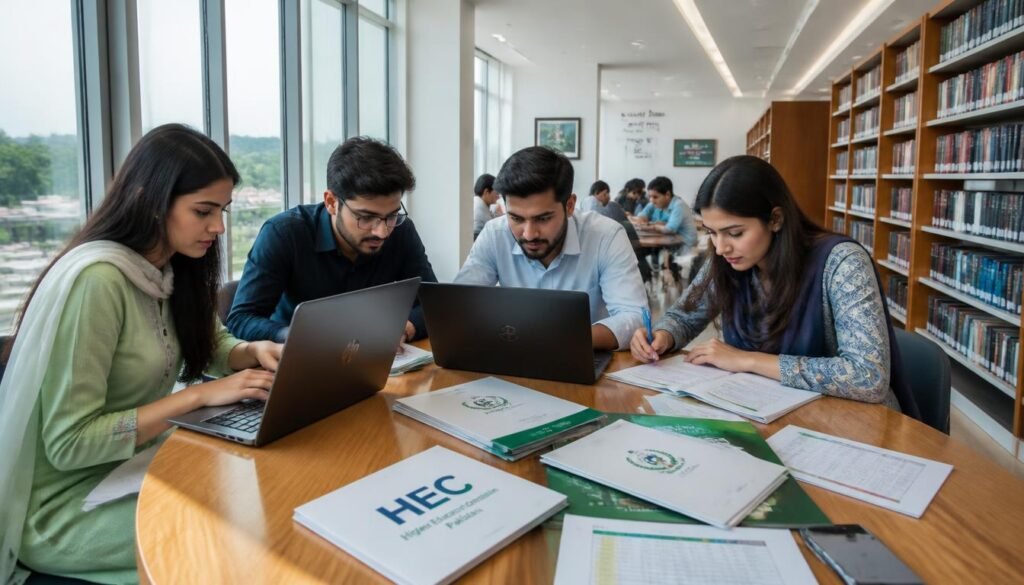
HEC Overseas Scholarship 2027:
The Higher Education Commission (HEC) of Pakistan runs some of the country’s biggest overseas scholarship programs, funding Pakistani students to complete MS/MPhil and PhD degrees at top universities abroad. The latest round targets universities ranked in the top 200 worldwide (QS or THE), which makes it one of the most valuable opportunities for Pakistani graduates.
Below are eight essential facts every applicant needs to know, including eligibility, the selection process, and how to prepare for the next batch.
Fact 1: What Is the Latest HEC Overseas Scholarship?
The most recent call was Overseas Scholarships for MS/MPhil & PhD Studies, Phase-III, Batch-IV. It funds study at universities ranked in the top 200 of the QS or Times Higher Education world rankings.
Key dates for that batch:
- Online registration opened: 9 August 2026
- Application deadline: 28 August 2026
- HEC Aptitude Test (HAT): 27 September 2026
If you missed this batch, don’t worry. HEC runs overseas scholarship batches regularly. Use this time to prepare for the next one.
Fact 2: It Covers Eight Priority Thematic Areas
The latest phase focuses on:
- Digital Transformation and Emerging Technologies
- Energy, Climate Change, and Environment
- Agriculture, Food Security, and Agri-Tech
- Health, Biotechnology, and Life Sciences
- Engineering and Advanced Manufacturing
- Natural and Physical Sciences
- Social Sciences, Business, and Governance
- Interdisciplinary and Strategic Areas
Your intended program should fit clearly into one of these areas.
Fact 3: Eligibility Rules
For PhD applicants:
- Pakistani or AJK national
- At least 18 years of education (MS/MPhil or equivalent)
- CGPA 3.0/4.0 or first division in your terminal degree
- No more than one second division in your academic career
- Maximum age: 40 (public-sector employees) or 35 (others)
For MS/MPhil applicants:
- At least 16 years of education (BS/BE or equivalent)
- CGPA 3.0/4.0 or first division
- Maximum age: 35 (public-sector employees) or 30 (others)
Fact 4: Selection Is Merit-Based With Provincial Quotas
Selection uses:
- HEC Aptitude Test (HAT) scores (valid for two years)
- Interviews for shortlisted candidates
- Provincial and regional quotas
A strong HAT score is one of the biggest factors, so prepare seriously.
Fact 5: The Application Process
- Register on the HEC e-Services Portal
- Fill in the online application and select your thematic area
- Pay the Rs. 3,000 processing fee through 1LINK
- Take the HAT test (general or subject category, as announced)
- If shortlisted, submit a printed application with supporting documents
- Attend the interview
- Receive the award and secure admission at an eligible top-200 university
Some candidates already hold admission; others secure it after selection. Check the conditions of each batch.
Fact 6: What the Scholarship Usually Covers
HEC overseas scholarships generally cover:
- Tuition fees
- Living allowance according to HEC’s approved rates for each country
- Airfare
- Health insurance
- Other approved allowances (such as books or research costs, depending on the program)
Exact coverage depends on the program’s approved terms, so read the award letter carefully.
Fact 7: There’s a Service Commitment
HEC scholarships usually require scholars to return to Pakistan and serve for a set period after completing their degree (commonly around five years), backed by a bond or surety. Breaking the bond can mean repaying the scholarship amount. Make sure you understand these terms before accepting.
Fact 8: How to Prepare for the Next Batch
1. Prepare for the HAT test now. Practice verbal, analytical, and quantitative reasoning. Your score stays valid for two years, so taking it early helps.
2. Shortlist top-200 universities in your field, and check their admission requirements and deadlines.
3. Prepare English test scores. Most top-200 universities require IELTS or TOEFL, and some ask for GRE.
4. Contact potential supervisors for PhD programs. Admission at a top university often depends on supervisor support.
5. Get your documents attested. HEC-attested degrees and transcripts are required. See HEC degree attestation for study abroad.
6. Write a strong research proposal and statement of purpose. Read how to write an SOP for study abroad.
7. Follow HEC announcements on the website and official social media channels.
Key Takeaways
- HEC funds MS/MPhil and PhD study abroad, often at top-ranked universities.
- The HAT test and academic record are key parts of selection.
- Scholars usually sign a bond to return and serve in Pakistan.
HAT Test Preparation Tips
- Know the format: verbal reasoning, analytical reasoning, and quantitative reasoning sections
- Practice past-style questions under timed conditions
- Build vocabulary for analogies, sentence completion, and comprehension
- Revise basic math: percentages, ratios, algebra, and data interpretation
- Take full mock tests to manage time and reduce stress
A strong HAT score stays valid for two years, so one good attempt can support several applications.
Other HEC-Linked Scholarships
HEC also coordinates or nominates candidates for several international scholarships, including:
- Chinese Government Scholarship (CSC)
- Stipendium Hungaricum (Hungary)
- Commonwealth Scholarships (UK)
- Various bilateral scholarships with countries such as Türkiye, Korea, and others
See fully funded scholarships for Pakistani students for the full list.
Tips for Success
- Aim for a HAT score well above the minimum
- Choose a thematic area where your previous degrees fit clearly
- Keep documents ready so you can apply quickly when calls open (windows can be short, as in the August 2026 batch)
- Prepare for interviews with questions on your research plan and how it benefits Pakistan
Understanding the HEC Service Bond
Most HEC overseas scholarships require scholars to return and serve in Pakistan for a set period. Before applying, understand:
- The service period, usually several years after completing your degree
- Guarantor and surety bond requirements
- Penalties if you do not return or complete the program
- Possible placement support in universities and research institutions
The bond is a serious commitment. Many scholars find it rewarding because it leads to faculty positions, but make sure it fits your long-term plans before signing.
Final Thoughts
The HEC overseas scholarship for 2027 is a powerful route for Pakistani graduates to study at the world’s top 200 universities fully funded. The latest batch closed on 28 August 2026, but new batches follow regularly. Prepare your HAT, English tests, documents, and research plan now, so you’re ready the moment the next call opens. For more research funding, read PhD scholarships for Pakistani students.
Always check official HEC announcements for current batches, eligibility, and deadlines.
Frequently Asked Questions
What is the latest HEC overseas scholarship?
The latest call was Overseas Scholarships for MS/MPhil & PhD Studies Phase-III, Batch-IV, for top-200 QS/THE-ranked universities, with the deadline on 28 August 2026.
What is the age limit for HEC overseas scholarships?
For PhD: 40 (public sector) or 35 (others). For MS/MPhil: 35 (public sector) or 30 (others).
What CGPA is required?
A minimum CGPA of 3.0/4.0 or first division in the terminal degree.
Is the HAT test required?
Yes. Selection is based on HAT scores and interviews. HAT scores remain valid for two years.
Do HEC scholars have to return to Pakistan?
Yes. HEC scholarships usually require scholars to return and serve in Pakistan for a set period, backed by a bond.
Can I apply for HEC scholarships while working?
Yes, but government employees may need a no-objection certificate from their department.
Does HEC cover my family’s expenses abroad?
Some programs include limited allowances, but most do not fully cover dependents. Check the current terms.




Questions? Ask below