
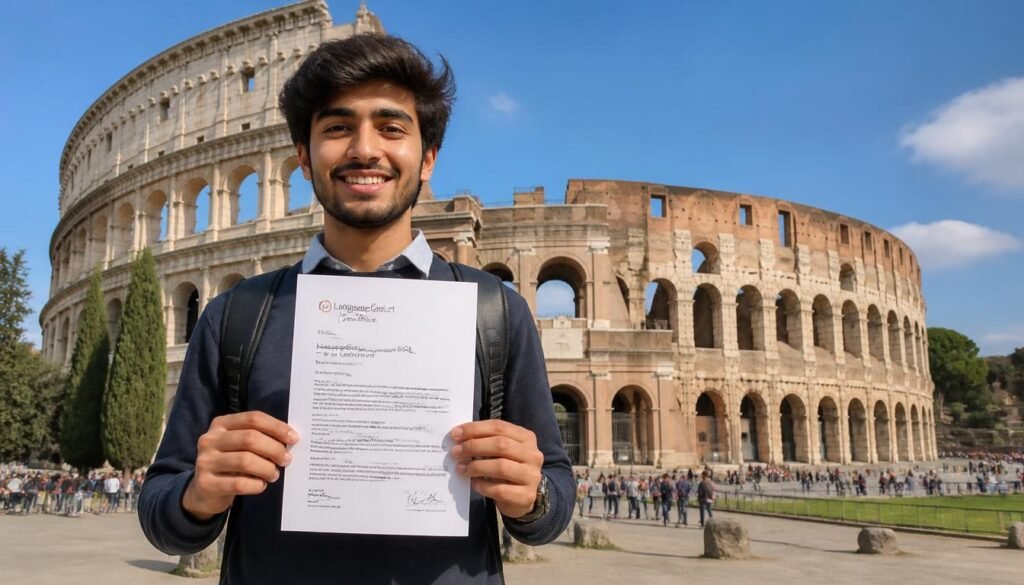
IELTS is expensive, stressful, and for many students the one thing standing between them and a European degree. The good news is that you can study in Italy without IELTS. Many Italian public universities accept other proof of English, most commonly a Medium of Instruction (MOI) letter from your previous institution.
This guide explains who can skip IELTS, which universities accept alternatives, and how to make sure your application and visa don’t get stuck because of your English proof.
Key Takeaways
- Many Italian public universities accept an MOI letter instead of IELTS for English-taught programs.
- The visa officer may still interview you in English, so your spoken English must match your MOI.
- Competitive programs such as Politecnico di Milano may still require IELTS or TOEFL — check each call.
Can You Really Study in Italy Without IELTS?
Yes. Italian universities set their own language requirements, and many of them accept:
- An MOI letter confirming your previous degree was taught in English
- Other tests such as Duolingo English Test, TOEFL, PTE, or Cambridge certificates
- An internal English test or interview run by the university
- Exemption for native speakers or graduates from English-speaking countries
What matters is that your proof meets the specific program’s rules. The same university may accept MOI for one master’s program and ask for IELTS 6.5 for another.
What Is an MOI Letter?
A Medium of Instruction (MOI) letter is an official letter from your university or college stating that your degree was taught and assessed entirely in English. Most Pakistani and Indian universities issue one on request. A strong MOI letter:
- Is printed on official letterhead
- Includes your full name, registration number, program name, and dates of study
- Clearly says the medium of instruction and examination was English
- Is signed and stamped by the Registrar or Controller of Examinations
Read our detailed guide on how to get an MOI letter for study abroad.
10 Top Universities to Study in Italy Without IELTS
The universities below have accepted an MOI letter or alternative English proof for many English-taught programs. Policies change and differ by program, so always confirm on the official program page.
| University | City | English Proof Commonly Accepted |
| University of Bologna | Bologna | MOI for many master’s programs, B2-level certificates |
| Sapienza University of Rome | Rome | MOI or B2 certificate for many programs |
| University of Padua | Padua | MOI accepted in several master’s programs |
| University of Pavia | Pavia | MOI, Duolingo, and other B2 proofs |
| University of Messina | Messina | MOI widely accepted |
| University of Naples Federico II | Naples | MOI for many English programs |
| University of Turin | Turin | MOI or B2 certificates |
| University of Pisa | Pisa | MOI or interview-based checks for some programs |
| University of Trento | Trento | MOI or English test depending on program |
| University of Camerino | Camerino | MOI widely accepted |
Tip: Highly competitive schools such as Politecnico di Milano and Bocconi usually insist on IELTS, TOEFL, or similar scores. If you want to skip IELTS completely, focus on public universities in Bologna, Rome, Padua, Pavia, and southern Italy.
Eligibility for Studying in Italy Without IELTS
You are most likely to be accepted without IELTS if:
- Your previous degree (bachelor’s for master’s applicants, or intermediate/A-Levels for bachelor’s applicants) was fully taught in English
- Your transcripts show good grades in English-taught subjects
- You can do well in an online interview if the university calls you for one
- You meet the program’s academic requirements, such as related subjects and minimum grades
Step-by-Step Application Process
- Shortlist programs that clearly accept an MOI or alternative proof, and screenshot the requirement from the official page.
- Get your MOI letter from your university’s examination or registrar office.
- Apply online directly to each university, uploading the MOI where the portal asks for “language certificate.”
- Prepare for interviews. Some universities check your English over a short video call.
- Receive admission and complete Universitaly pre-enrollment.
- Prepare visa documents, including legalized degrees (DOV or CIMEA), your admission letter, and proof of funds (about €10,180 per year for 2026–27).
- Attend your visa appointment. Be ready to answer basic questions in English about your program and plans.
Will the Visa Officer Ask for IELTS?
This is the part many students worry about. The Italian embassy generally follows the university’s admission decision. If the university accepted your MOI, that is usually enough for the visa. Still, your visa interview is effectively an English check: if you can’t answer simple questions about your course, city, and funding, that can raise concerns. Practice speaking confidently about your plans before the appointment. See our full Italy study visa from Pakistan guide.
Benefits of Skipping IELTS
- Save money. IELTS costs roughly PKR 70,000 or more in Pakistan, and INR 18,000 or more in India.
- Save time. No months of preparation and waiting for test dates.
- Apply sooner. You can meet early-round deadlines for the best programs.

Drawbacks to Keep in Mind
- Fewer program choices. Some top programs will not accept an MOI.
- Scholarship competition. Some merit scholarships favor applicants with high test scores.
- Future needs. If you later move to the UK or Canada for work or further study, you may need IELTS anyway.
If your English is strong, taking Duolingo (cheaper and online) can be a good middle option that opens more doors.
Quick Checklist Before You Apply
- A detailed MOI letter on official letterhead
- A screenshot of each program page showing that an MOI is accepted
- Attested degrees and transcripts
- A strong, program-specific motivation letter
- Interview practice for both the university and the embassy
How to Prepare for an English Interview Without IELTS
Some Italian universities and the visa section may hold a short online interview to confirm your English. Prepare as if it were a real test:
- Practice explaining your study plan in two minutes: why this program, why Italy, and your career goal
- Revise the main courses from your transcript so you can describe them confidently
- Record yourself answering five common questions and remove long pauses and filler words
- Test your internet, camera and microphone a day before, and keep your documents nearby
- Answer in full sentences, speak slowly and do not memorize long scripts
A calm, clear conversation reassures the panel that your MOI letter reflects your real ability. Students who skip IELTS but prepare for the interview rarely face problems.
Final Thoughts
Studying in Italy without IELTS is realistic for most students who completed their previous education in English. Target public universities that clearly accept an MOI, get a strong, detailed MOI letter, and prepare to speak confidently in interviews and at the embassy. Combine that with an early application and a DSU scholarship application, and Italy can be one of the cheapest and simplest routes to a European degree. You can also explore UK universities without IELTS for Pakistani students if you want to compare options.
Frequently Asked Questions
Is IELTS mandatory for an Italy student visa?
Not always. If your university accepts an MOI letter and admits you, the embassy usually accepts that. However, the embassy can assess your English during the visa interview.
Which Italian universities accept an MOI letter?
Many public universities, including Bologna, Sapienza, Padua, Pavia, Messina, and Naples Federico II, accept an MOI for various English-taught programs. Always confirm per program.
Can I get a scholarship in Italy without IELTS?
Yes. The DSU regional scholarship is based on income and merit, not test scores, so you can receive it with an MOI-based admission.
Is Duolingo accepted in Italy?
Many Italian universities accept the Duolingo English Test, usually with a score of around 105–120 depending on the program.
Can bachelor’s students study in Italy without IELTS?
Yes, if their intermediate or A-Level studies were in English and the university accepts an MOI or school letter. Some bachelor’s programs also require an entrance test.
Is an MOI letter accepted for a bachelor’s in Italy?
Some universities accept it for bachelor’s applicants from English-medium schools, but many ask for IELTS or an entrance test. Check the program’s admission call.
Can I get an Italy visa refusal because I have no IELTS?
Not usually because of IELTS alone, but a weak interview can raise doubts. Your MOI and your spoken English should support each other.




1 comment