
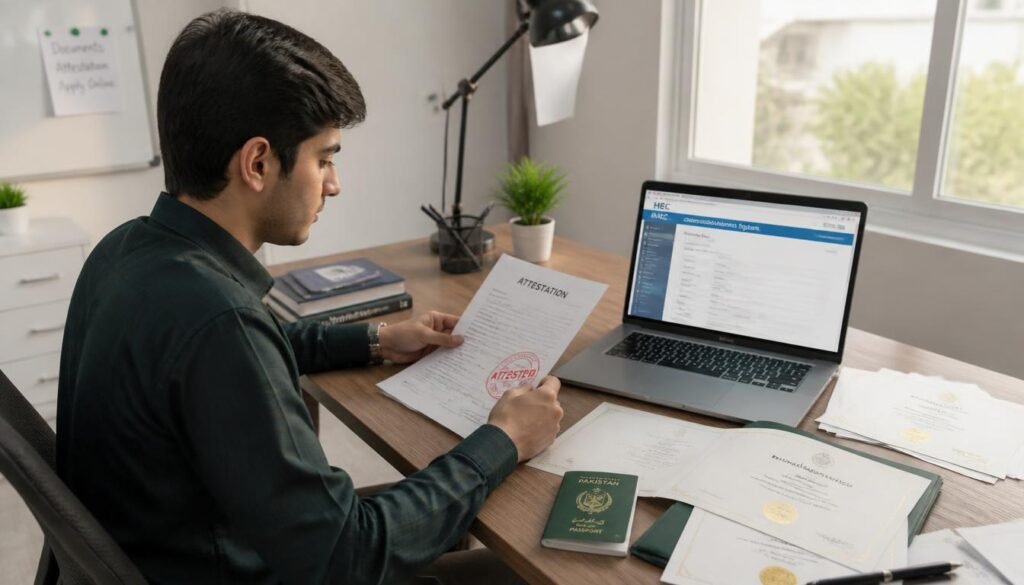
IBCC Equivalence Certificate for Study Abroad:
Every Pakistani student planning to study abroad reaches the same confusing question at some point: do I need an IBCC equivalence certificate, IBCC attestation, or both? Get it wrong and your university application or visa can be delayed by weeks.
Below you will learn exactly what the IBCC equivalence certificate is, when you need it, how it differs from attestation, and how to apply step by step.
Key Takeaways
- Equivalence converts foreign qualifications into Pakistani grades; attestation verifies Pakistani certificates.
- Most students going abroad need IBCC attestation of Matric and FSc, not an equivalence certificate.
- After IBCC, many countries also require MOFA apostille.
What Is IBCC?
The Inter Boards Coordination Commission (IBCC) is the Pakistani body that coordinates the country’s education boards. For students it does two main jobs:
- Equivalence: it converts foreign or non-standard qualifications (like O-Levels, A-Levels, American High School Diploma, or IB) into their Pakistani equivalent, such as Matric or Intermediate.
- Attestation: it verifies and stamps Pakistani Matric (SSC) and Intermediate (HSSC) certificates so that foreign institutions and embassies accept them as genuine.
Equivalence vs. Attestation: What’s the Difference?
| IBCC Equivalence | IBCC Attestation | |
| Who needs it | Students with foreign or non-Pakistani board qualifications (O/A-Levels, IB, American diploma) | Students with Pakistani board certificates (Matric, FSc, ICS, FA) |
| Purpose | Converts your qualification into a Pakistani equivalent with marks or percentage | Verifies your Pakistani certificates for use abroad |
| Typical use | Admission in Pakistan, government jobs, and some foreign applications | Foreign university admissions, visas, embassy requirements |
Simple rule:
- Studied Matric/Intermediate in Pakistan? You mainly need IBCC attestation for study abroad.
- Studied O/A-Levels or another foreign system? You need IBCC equivalence first, and then attestation if the embassy or university asks for it.
When Do You Need It for Study Abroad?
Many universities and embassies ask for attested school certificates, especially:
- Italy: for the DOV or CIMEA process and visa documents
- Germany: for bachelor’s applicants, certificate verification through uni-assist or the university
- China, Turkey, and Hungary: attested intermediate documents for scholarship and admission files
- Gulf countries: attestation is almost always compulsory
Even if a university accepts plain scans, the visa stage often requires attested and apostilled documents, so it’s smart to get them done early.
IBCC Equivalence Fees
According to IBCC’s official FAQs:
- Foreign qualifications (O/A-Levels, etc.): Rs. 6,000 per qualification
- Local qualifications: Rs. 4,000 per qualification
- Urgent equivalence (O/A-Levels only): Rs. 12,000 per qualification
Standard processing takes about 15–20 working days. Fees can change, so confirm on the IBCC website before paying.
7 Easy Steps to Get Your IBCC Equivalence Certificate
Step 1: Register on the IBCC portal. Create your account on the official IBCC e-services and equivalence portal using your CNIC or B-Form details.
Step 2: Fill in the application form. Enter personal details and education history exactly as they appear on your certificates.
Step 3: Upload your documents. Usually these are:
- O/A-Level or foreign certificates and statements of results
- CNIC or B-Form copy
- Passport copy (if applicable)
- School leaving or attendance certificates, if asked
Step 4: Pay the fee online through the portal’s payment link or a bank challan.
Step 5: Choose your submission method. IBCC offers walk-in submission at regional offices, courier submission, or online submission for photocopies.
Step 6: Track your application on the IBCC dashboard.
Step 7: Receive your certificate by courier or collect it from the regional office.
How to Get IBCC Attestation for Study Abroad
For Pakistani Matric and Intermediate certificates:
- Apply on the IBCC e-services portal for attestation
- Upload scans of your certificates and CNIC
- Pay the attestation fee per document
- Submit originals by courier or at a regional office (IBCC has offices in Islamabad, Lahore, Karachi, Peshawar, Quetta, and other cities)
- Receive your stamped documents
Don’t Forget: MOFA Attestation and Apostille
Pakistan joined the Hague Apostille Convention in 2023. For countries that are members of the convention (most of Europe, including Italy and Germany), the Ministry of Foreign Affairs (MOFA) can issue an apostille on your documents after IBCC or HEC verification. For non-member countries, regular MOFA attestation and embassy legalization may still be required.
Your typical document chain looks like this:
- School certificates: Board verification → IBCC attestation → MOFA apostille
- University degrees: HEC attestation → MOFA apostille
Read our guide to HEC degree attestation for study abroad for the university-level process.
Document Checklist by Destination
Requirements differ by country, so use this as a starting point:
| Destination | What Pakistani Students Usually Need |
| Italy | IBCC-attested Matric/Inter, HEC-attested degree, MOFA apostille, DOV or CIMEA |
| Germany | Attested certificates for uni-assist or the university, apostilled copies for the visa file |
| China | Attested intermediate and degree documents, plus a police character certificate |
| Turkey | IBCC-attested intermediate for bachelor’s; HEC-attested degree for master’s |
| UK / Canada | Usually plain transcripts for admission; attestation is rarely required, but keep it ready |
| Gulf countries | Full attestation chain plus embassy legalization in almost every case |
Pro tip: Order two or three sets of attested copies at once. Different universities, scholarship bodies, and embassies often keep your copies, and repeating the process later wastes weeks.
Common Mistakes to Avoid
- Confusing equivalence with attestation and applying for the wrong service
- Name mismatches between your passport, CNIC, and certificates. Fix these before applying
- Waiting until after admission. Attestation and apostille can take weeks, and visa appointments won’t wait
- Missing documents, such as not uploading every O-Level statement of result
Which Documents Need IBCC, HEC or MOFA?
Pakistani students often send the wrong document to the wrong office. Use this rule of thumb:
- Matric, O Level, FSc and A Level certificates: IBCC attestation (and equivalence for O/A Levels if required)
- Bachelor’s and master’s degrees and transcripts: HEC degree attestation
- Documents for apostille countries such as Italy, Germany and Spain: MOFA apostille after IBCC or HEC
- Documents for non-apostille countries: MOFA attestation, then the embassy’s own legalization if required
- Birth certificate, domicile or family certificates: MOFA attestation after the issuing authority verifies them
Check the embassy checklist for your target country before you start, because the order matters. Sending documents to MOFA before IBCC or HEC usually means starting again.
Final Thoughts
The IBCC equivalence certificate for study abroad is a small step that causes big delays when it’s ignored. If you studied O/A-Levels, get your equivalence done first. If you studied in a Pakistani board, go straight for IBCC attestation. Then complete the MOFA apostille. Doing this early keeps your university applications and visa file ready. Next, follow our step-by-step guide on how to apply to foreign universities from Pakistan.
Frequently Asked Questions
Do I need an IBCC equivalence certificate to study abroad?
Only if you studied a foreign or non-Pakistani qualification such as O/A-Levels. Students from Pakistani boards usually need IBCC attestation instead.
How much is the IBCC equivalence fee?
According to IBCC, it is Rs. 6,000 per foreign qualification and Rs. 12,000 for urgent O/A-Level equivalence. Confirm current fees on the official website.
How long does IBCC equivalence take?
Standard processing takes about 15–20 working days. Urgent service is available for O/A-Levels.
Is an IBCC equivalence certificate valid forever?
Yes. IBCC states that an equivalence certificate is valid indefinitely unless the qualification itself is time-bound.
Do I need an apostille after IBCC attestation?
For most European countries, yes. MOFA issues an apostille after IBCC or HEC verification for use in Apostille Convention countries.
Can I apply for IBCC attestation online?
Yes. IBCC offers an online portal for applications, fee payment and courier options, although some cases still need a visit to a regional office.
Do O and A Level students need equivalence to study abroad?
Only if the foreign university or embassy specifically asks for Pakistani equivalence. Many universities accept Cambridge results directly.




Questions? Ask below