
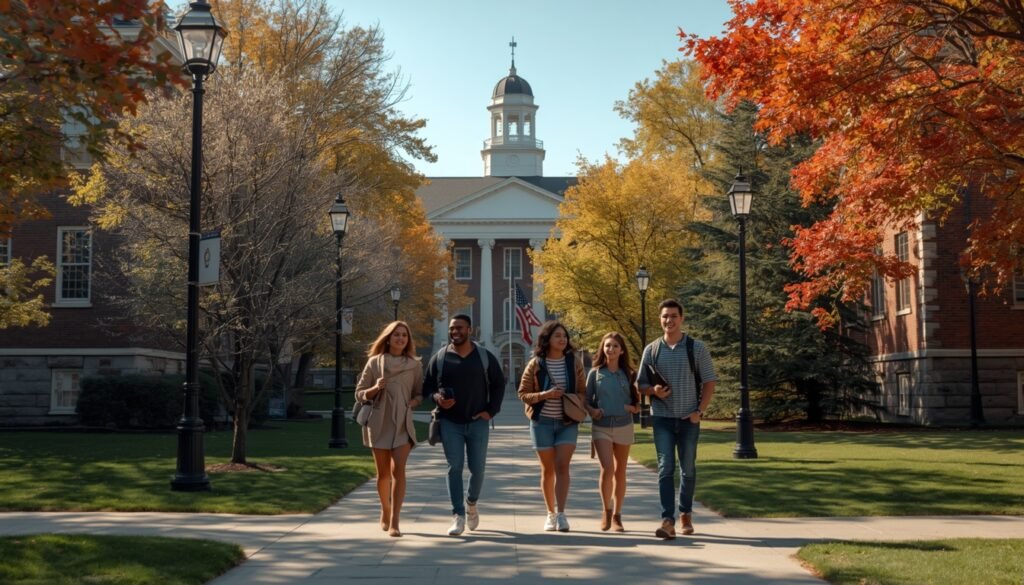
Low Cost Universities in USA:
A US degree has a reputation for being very expensive, and at private universities like Harvard or Stanford it can cost more than USD 80,000 per year. But the United States has thousands of colleges and universities, and many public universities and community colleges charge international students much less. With the right choices and scholarships, an American degree can be surprisingly affordable.
Below are the best low-cost US options, explains real costs, and covers the latest F-1 visa changes you must know for 2027.
Key Takeaways
- Public universities in lower-cost states and community colleges offer the cheapest US routes.
- Graduate assistantships can cover tuition and pay a stipend.
- F-1 rules changed in 2025–2026, so check the latest updates before applying.
Important: F-1 Visa Changes to Know (2025–2026)
US student visa policy has changed a lot recently:
- Interviews in your home country: since September 2025, applicants should schedule visa interviews at a US embassy or consulate in their country of nationality or residence
- Social media vetting: expanded screening requires applicants to list social media usernames on the DS-160, and many applicants are asked to set profiles to public
- Travel restrictions: an expanded travel ban effective 1 January 2026 affects 39 countries. Pakistan, India, and Bangladesh are not on the list, but some countries (such as Nigeria) face restrictions on F, M, and J visas
- Fixed-term admission rule: a rule replacing “duration of status” with fixed periods was scheduled for September 2026 but was blocked by a federal court at the time of writing. Watch for updates
- OPT: still available, but with more oversight
Always check EducationUSA and your university’s international office for the latest rules.
What Makes a US University “Low Cost”?
Average international tuition at US public universities is often USD 25,000–45,000 per year. Low cost options usually charge USD 8,000–20,000 per year, especially at:
- Regional public universities in states such as North Dakota, Minnesota, Mississippi, Louisiana, Kansas, and Texas
- Community colleges (two-year programs that let you transfer to a four-year university)
- Universities with flat or reduced tuition for international students
12 Low Cost Universities in USA for International Students
| University | State | Approx. International Tuition (USD/year) |
| Minot State University | North Dakota | 8,000 – 10,000 |
| Dickinson State University | North Dakota | 8,000 – 12,000 |
| Valley City State University | North Dakota | 8,000 – 10,000 |
| Emporia State University | Kansas | 9,000 – 12,000 |
| Delta State University | Mississippi | 9,000 – 11,000 |
| Mississippi Valley State University | Mississippi | 8,000 – 10,000 |
| Northwestern State University | Louisiana | 10,000 – 14,000 |
| University of Texas Permian Basin | Texas | 12,000 – 16,000 |
| Texas A&M University–Kingsville | Texas | 14,000 – 18,000 |
| Southeast Missouri State University | Missouri | 13,000 – 17,000 |
| University of Minnesota Crookston | Minnesota | 12,000 – 16,000 |
| Western Kentucky University | Kentucky | 15,000 – 20,000 |
Fees change yearly, so confirm current international tuition on each university’s website.
The Community College Route
Community colleges charge international students roughly USD 7,000–15,000 per year. After two years, you can transfer to a four-year university to complete your bachelor’s degree, often saving USD 30,000–60,000 overall. Many community colleges also have lower English requirements and don’t require the SAT.
Graduate Students: Funding Can Make It Nearly Free
At the master’s and PhD level, many US universities offer:
- Teaching or research assistantships with tuition waivers and monthly stipends
- Graduate fellowships for strong applicants
- In-state tuition rates for students with assistantships at some universities

PhD programs in STEM are often fully funded, which makes them one of the best “low cost” routes to the US. Read our PhD scholarships for Pakistani students guide.
Scholarships for International Students
- Merit scholarships: many public universities automatically award USD 2,000–10,000 per year based on grades and test scores
- Fulbright (for eligible countries, including Pakistan and India) for master’s and PhD study
- University international student awards, often renewable if you maintain a minimum GPA
- Assistantships at the graduate level
See our full list of fully funded scholarships for Pakistani students.
Living Costs
Low cost universities are usually in smaller towns with lower living costs:
| Expense | Approx. Monthly Cost (USD) |
| On-campus housing or shared apartment | 400 – 800 |
| Food | 250 – 400 |
| Transport | 50 – 100 |
| Health insurance (required) | 100 – 250 |
| Books and personal expenses | 100 – 200 |
That’s roughly USD 10,000–15,000 per year, compared with USD 20,000+ in New York, Boston, or San Francisco.
Work Rights
- On campus: up to 20 hours per week during semesters, and full-time during breaks
- CPT (Curricular Practical Training) for internships related to your program
- OPT: 12 months of work after graduation, plus a 24-month STEM extension for eligible STEM degrees
Month-by-Month Timeline for the Fall 2027 Intake
| Month | Action |
| Jun – Aug 2026 | Shortlist universities and take TOEFL/IELTS/Duolingo and SAT/GRE if needed |
| Sep – Dec 2026 | Apply (many priority scholarship deadlines fall between November and February) |
| Jan – Mar 2027 | Receive admission and scholarship decisions |
| Mar – Apr 2027 | Pay the deposit and receive your I-20 |
| Apr – Jun 2027 | Pay the SEVIS fee, complete the DS-160, and attend your visa interview |
| Jul – Aug 2027 | Travel and attend orientation |
Book your visa interview as early as possible, since wait times at US embassies can be long in summer.
English Requirements
Most universities require TOEFL, IELTS, or Duolingo, but some offer waivers for students from English-medium education. See study in USA without IELTS for Pakistani students.
How Graduate Assistantships Work
For master’s and PhD students, assistantships can turn an expensive degree into an affordable one. There are three main types:
- Teaching Assistant (TA): helps teach or grade undergraduate courses
- Research Assistant (RA): works on a professor’s funded research project
- Graduate Assistant (GA): supports offices such as admissions or libraries
Many assistantships include a full or partial tuition waiver plus a monthly stipend, usually for around 20 hours of work per week. Email professors in your field, highlight relevant skills, and ask departments directly about funding for new students.
Final Thoughts
Low cost universities in the USA for international students make an American degree much more realistic than most families think. Choose regional public universities or the community college route, apply for merit scholarships, and target funded graduate programs if you’re applying for a master’s or PhD. Keep a close eye on changing visa rules and prepare thoroughly for your interview with our USA F1 visa interview questions guide.
Frequently Asked Questions
What is the cheapest university in the USA for international students?
Regional public universities such as Minot State, Dickinson State, Delta State, and Emporia State charge some of the lowest international fees, often USD 8,000–12,000 per year.
Can international students study in the USA for free?
Fully funded PhD programs and some master’s assistantships cover tuition and pay a stipend. Undergraduate full scholarships exist but are very competitive.
Are Pakistani and Indian students affected by the 2026 US travel ban?
No. Pakistan, India, and Bangladesh are not on the travel ban list effective 1 January 2026. Other visa rule changes still apply.
Is community college a good option for international students?
Yes. It’s much cheaper and lets you transfer to a four-year university to complete your degree, but check transfer agreements first.
Can I work in the USA after graduation?
Yes. F-1 graduates can use OPT for 12 months, plus a 24-month extension for eligible STEM degrees.
Can international students get in-state tuition?
Generally no, but some universities offer reduced rates or regional exchange programs. Scholarships are the main way to lower costs.
Is OPT still available after graduation?
OPT has remained available, but rules and policies can change. Check the latest USCIS guidance before planning your career.

Questions? Ask below